November 2026
Leaf Season in the West End: How to Rake Without Wrecking Your Back
If you live in Richmond's West End, you know the drill. The oaks and maples put on a beautiful show for a few weeks, and then every one of those leaves ends up on your lawn, your driveway, and your gutters.
Raking doesn't seem like a big deal. It's not heavy lifting, and it's not a sport. But every fall, we see the same pattern in our office: people spend a Saturday clearing the yard, feel fine that evening, and wake up Sunday with a stiff lower back, sore shoulders, or a neck that won't turn.
Let's talk about why that happens and what you can do about it.
Why Raking Is Harder on Your Body Than It Looks
When I look at someone who's sore after yard work, I always look at how the lower back and the shoulders are working together. Raking is a perfect example of how those two areas affect each other.
Think about what your body does with a rake in hand:
- You hinge at the hips over and over. You lean forward to reach, pull back, and lean forward again, often for hours.
- Your shoulders repeat the same motion. Reach, pull, reach, pull, usually with the same arm leading every time.
- You twist. Moving leaves into a pile or onto a tarp adds rotation through your spine.
- You bend and lift. Scooping leaves into bags or bins adds load to a back that's already tired.
Any one of these is fine on its own. The trouble is the repetition. Doing the same movement hundreds of times in a row puts steady stress on the same joints, muscles, and discs. We've written before about how repetitive strain affects your spine, and raking is a classic case of it, just packed into one afternoon instead of spread out over years.
How Your Lower Back and Shoulders Pass the Problem Along
Your body is connected. When your lower back gets tired from constant hinging, your upper body often picks up the slack. Your shoulders and upper back start working harder to pull the rake. Your neck tightens to help stabilize everything.
The reverse happens too. If one shoulder is doing most of the work, your body can shift and twist to compensate, and that uneven pull travels down into your mid and lower back.
All of this runs through your nervous system. Your spine protects the nerves that carry messages between your brain and the rest of your body. When joints in your spine aren't moving well or are out of alignment, which we call a subluxation, those messages may not flow as clearly. That can show up as muscles that stay tight, areas that tire quickly, or soreness that hangs around longer than it should. This is part of why that ache between your neck and shoulder blade can be connected to what's happening further up or down the spine, something we cover in why your shoulder pain might actually start in your neck.
Before, During, and After: Simple Ways to Rake Smarter
Here's what I tell patients when they mention a big yard day is coming up.
Take breaks
You don't have to clear the whole yard in one go. Every so often, stop, stand up tall, take a few easy breaths, and walk around. Breaking up the repetition gives your back and shoulders a chance to reset. If your yard is large, think about splitting the job over a couple of days.
Switch sides
Most of us rake with the same hand leading every time. If you can, swap your grip and lead with the other side for a while. It will feel awkward at first, and that's okay. Changing sides spreads the work out so one side of your body isn't doing all of the reaching, pulling, and twisting.
A few other small habits that may help:
- Keep the rake close to your body instead of reaching far out in front of you.
- Move your feet to turn rather than twisting at your waist.
- Make smaller piles so you're not dragging heavy loads of leaves.
- Bend your knees when you pick up leaves, and keep bags light enough to lift comfortably.
Use heat afterward
Once you're done, gentle heat is a nice way to help tired muscles relax. A warm shower or a heat pack on your lower back or shoulders can feel great after a long day outside. Keep it comfortable, never hot enough to irritate your skin.
Most importantly: get your kids to do it
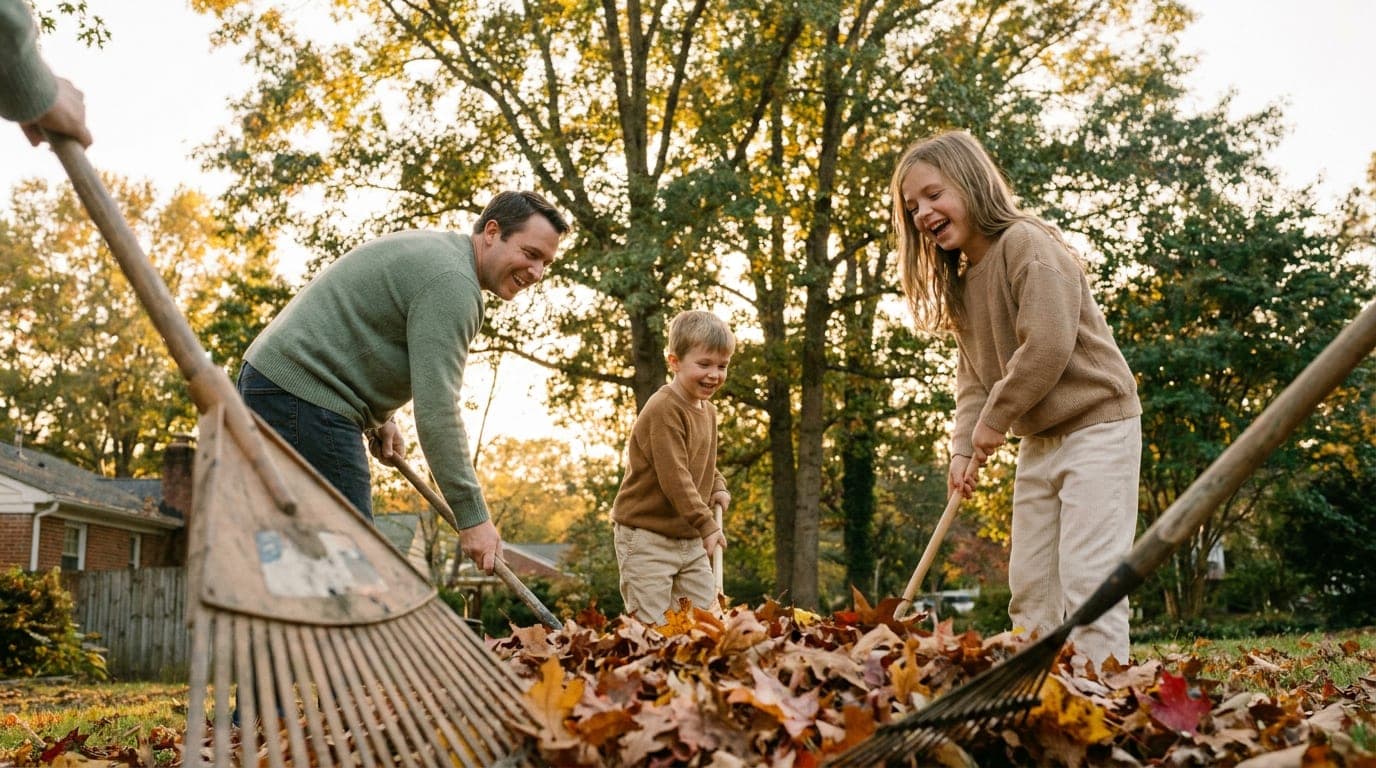
I'm only half joking here. If you have kids or teenagers at home, leaf season is a great time to hand them a rake. It's good exercise for them, it teaches responsibility, and it gives your back a well-earned break. Turn it into a family project, or let the kids take the lead while you supervise from the porch. Either way, your spine will thank you.
When Should You Come In?
A little soreness after a long day of yard work is normal and often fades in a day or two. But it's worth getting checked if:
- The soreness lingers for more than a few days or keeps coming back every time you do yard work
- Your lower back and shoulders, or your neck, seem to flare up together
- You notice you're favoring one side or can't turn or bend comfortably
- Everyday tasks like getting dressed or picking up your kids start to feel harder
If you have numbness or weakness in your legs, trouble controlling your bladder or bowels, or pain after a fall, please see a medical doctor right away.
At Omni Family Chiropractic, we don't just look at the spot that hurts. Dr. Maxine and I look at how your whole spine is working, starting with the upper neck, where the top two vertebrae sit right next to your brain stem. We use gentle, specific adjustments and technology like posture and thermal scans to see what's really going on. Everyone responds differently, but our goal is to help your body move and function well so you can enjoy the season, not just survive it.
Enjoy the Leaves
Fall in Richmond is too beautiful to spend it laid up on the couch. Pace yourself, switch sides, warm up those muscles afterward, and recruit some helpers if you can.
If your back or shoulders are telling you something this leaf season, we'd be happy to take a look. You can call our office at (804) 214-6236 or book online through our Jane scheduling page. We're right here on Patterson Avenue whenever you're ready.