October 2026
The Hidden Link Between Your Neck and Shoulder Pain: Meet the Levator Scapulae
Have you ever reached up to rub that tender spot where your neck meets your shoulder—only to find it never quite goes away? You stretch, you massage, you adjust how you sit, and still that deep ache lingers. If this sounds familiar, there's a good chance one specific muscle is at the center of your discomfort: the levator scapulae.
Understanding this muscle can completely change how you think about your neck and shoulder pain. More importantly, it explains why treating one area alone rarely gives you lasting relief.
What Is the Levator Scapulae?
The name sounds complicated, but the muscle has a simple job. "Levator" means to lift, and "scapulae" refers to your shoulder blade. So this muscle literally helps lift your shoulder blade.
Here's what makes it so important for understanding your pain:
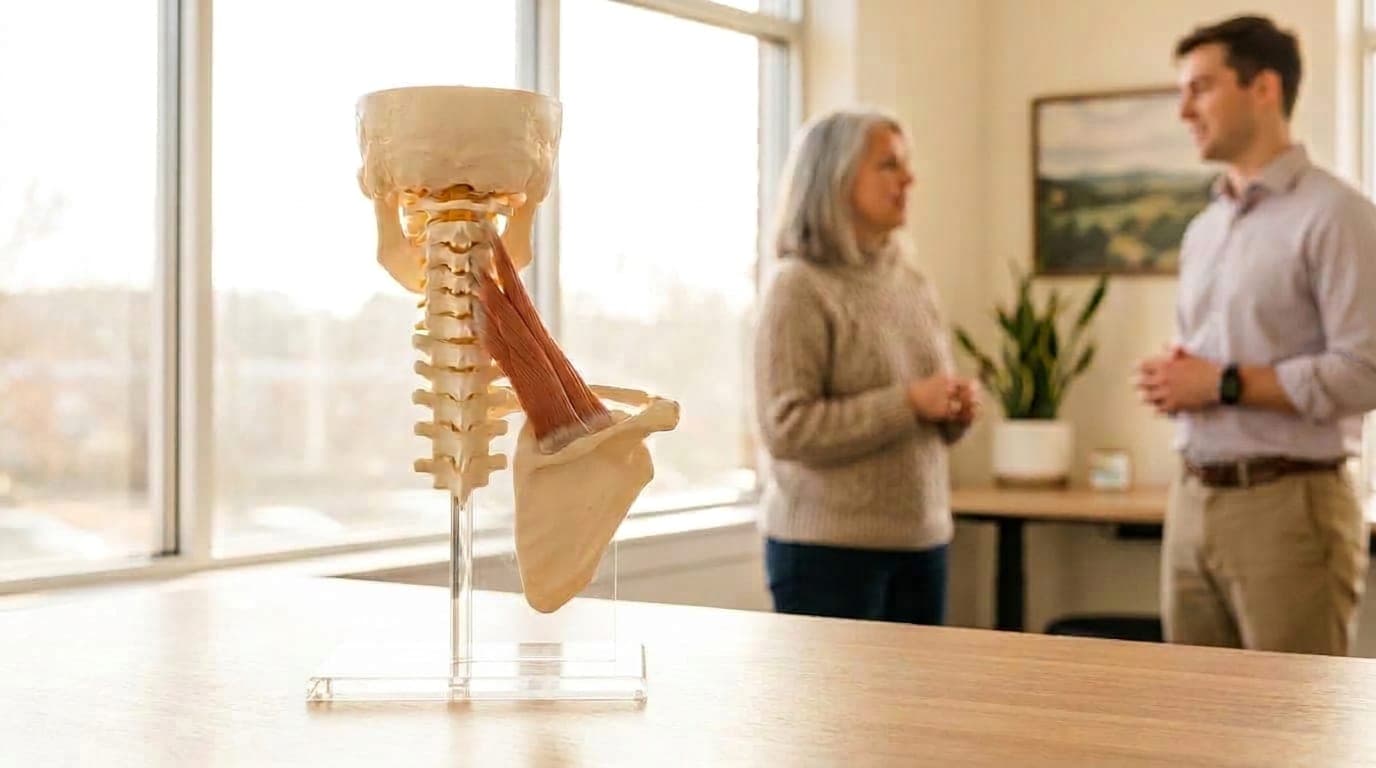
- It attaches to the upper, inner corner of your shoulder blade (the part closest to your spine)
- It runs up the side of your neck and connects to the top four bones of your cervical spine (the upper neck vertebrae)
- It works constantly to support your head, shrug your shoulders, and tilt your neck
Think of it like a strong rope stretched between your upper neck and your shoulder blade. When one end gets tight or strained, you feel the pull on both ends.
Why Your Neck and Shoulder Pain Are Connected
Because the levator scapulae links your upper neck directly to your shoulder blade, these two areas are far more connected than most people realize. A problem in one spot creates tension in the other.
What we often see in practice: someone comes in sure they have a shoulder problem, with a shoulder blade that burns after hours at a desk. When we look at the upper neck as well, the picture often makes more sense, and caring for both areas together tends to give people their best chance at relief.
This is exactly why so many people stay frustrated for months. They chase the shoulder pain while ignoring the neck, or they focus on the neck while the shoulder keeps feeding tension right back up the chain.
The Nervous System Piece You Can't Ignore
Here's where things get really important. The nerves that control the levator scapulae—and so many muscles in your neck and upper back—exit from those same upper cervical vertebrae where the muscle attaches.
When one of those spinal bones loses its normal motion or position, we call it a subluxation. In chiropractic, we understand that a subluxation can irritate nearby nerves and interfere with the signals traveling between your brain and body. The result?
- Muscles that stay tight no matter how much you stretch
- Pain that spreads instead of staying in one spot
- Problems that keep coming back after temporary relief
Your body isn't broken—it's responding exactly as it should to interference in the nervous system. When that interference is addressed, many people find their muscles are better able to relax and recover.
Why Both Areas Must Be Addressed Together
This is the key lesson. If you only treat your shoulder blade pain, you leave the upper neck tension in place—and it will pull everything back out of balance. If you only treat the neck, the strained shoulder blade attachment keeps the irritation alive.
True relief comes from addressing the entire system at once:
- Correcting subluxations in the upper cervical spine
- Releasing tension in the levator scapulae and surrounding muscles
- Restoring healthy nerve communication so your body can self-regulate
- Giving you movement and posture strategies to keep it from returning
When we handle both ends of that "rope" together, your body finally gets the chance to let go of the pain pattern it's been stuck in.
Let's Find the Real Source of Your Pain
If you've been battling stubborn neck, shoulder, or mid-back pain that just won't quit, your levator scapulae and upper cervical spine may be the missing piece. You don't have to keep guessing—or keep living with it.
At Omni Family Chiropractic in Richmond, VA, we take the time to examine how your whole spine and nervous system are working together, not just the spot that hurts. We'll help you understand what's really going on and build a plan to address it at the source.
Ready to connect the dots on your pain? Call Omni Family Chiropractic today to schedule your evaluation—your neck, shoulders, and whole body will thank you.