September 2026
The Migraine Connection: Why Your Headaches Rarely Travel Alone
If you've ever suffered through a migraine, you know it's not "just a headache." It's a whole-body experience that can steal a day (or more) from your life. But here's something many people don't realize: migraines almost never travel alone. They come with a cluster of companion symptoms — and those symptoms often point us toward the real source of the problem.
Let me walk you through the connections I see every week here at Omni Family Chiropractic.
The Symptoms That Show Up Together
When someone comes to me with migraines, I rarely hear about the headache alone. Instead, I hear a familiar story that includes several of these:
- Upper neck pain and stiffness — especially right where your skull meets your spine
- Trapezius muscle spasm — that tight, aching band across the tops of your shoulders
- Poor sleep — trouble falling asleep, staying asleep, or waking up unrefreshed
- High stress levels — a nervous system that feels stuck in "always on" mode
- Dizziness or balance issues — sometimes called vestibular problems
- Sensitivity to light, sound, or smells
When you see all of these listed together, a pattern starts to emerge. These aren't six separate problems. They're often six signs of one thing: a nervous system under pressure.
What Ties It All Together
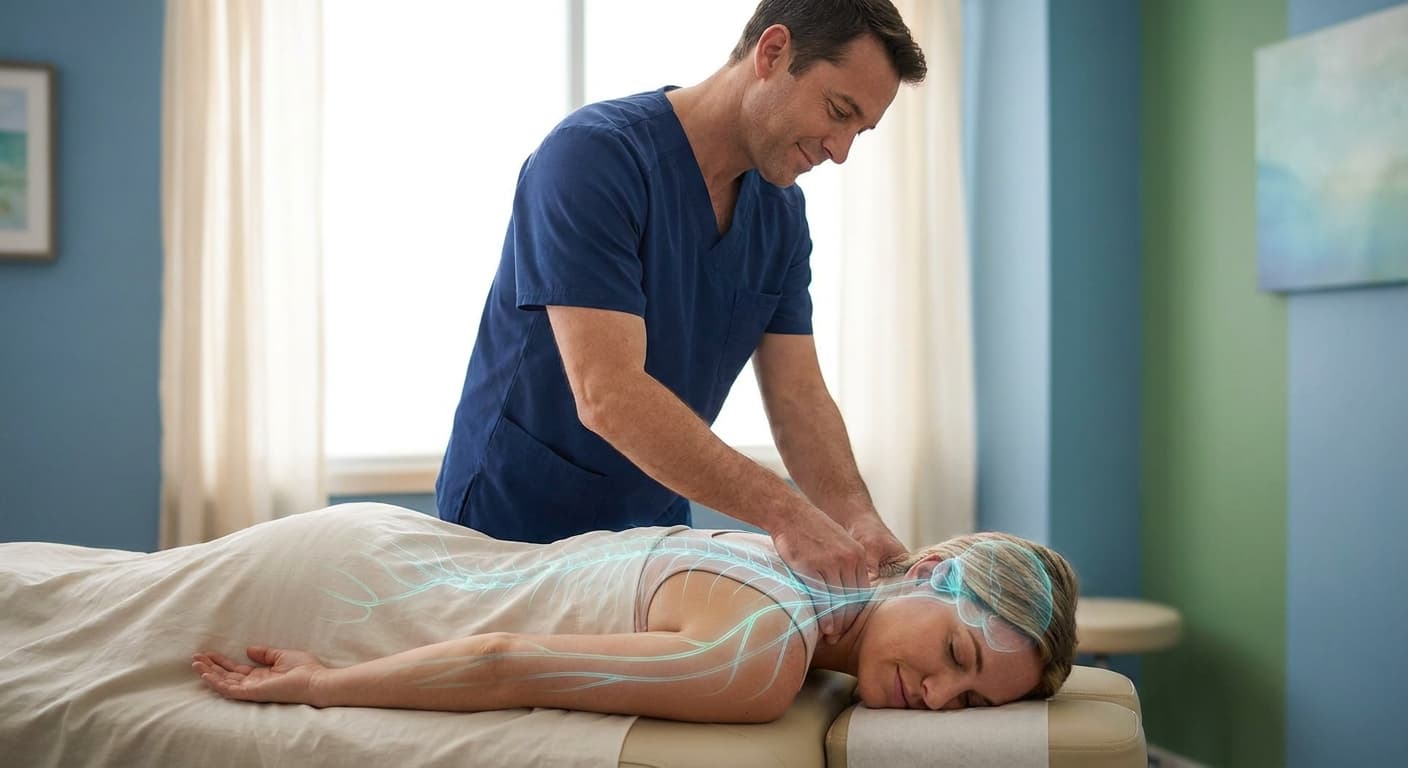
Your brainstem and the top bones of your neck are like a busy intersection. Almost every nerve message traveling between your brain and body passes through this area. When the top vertebrae in your neck lose their proper position or movement — what we call a subluxation — it creates interference at that intersection.
"I came in for migraines that had bothered me for years. I didn't even mention my neck stiffness because I figured that was just from getting older. After a few weeks of care, both were fading — and I finally started sleeping through the night." — a patient in her 40s
Think about it this way. That subluxation in your upper neck can:
- Irritate the nerves that contribute to head pain
- Trigger muscle tension in your neck and traps as your body tries to protect the area
- Disrupt balance signals because the upper neck helps your brain know where your head is in space (hello, dizziness)
- Keep your stress system revved up, which makes deep, restful sleep nearly impossible
When one intersection is jammed, traffic backs up everywhere. That's why treating the migraine alone — with medication that only masks the pain — often leaves the other symptoms untouched.
Why the Nervous System Is the Real Story
Your nervous system is the master controller of your entire body. It runs your muscles, your sleep cycles, your stress response, and your sense of balance. When there's interference in the spine — particularly at the top of the neck — your nervous system can't do its job smoothly.
This is why so many of my migraine patients notice benefits beyond fewer headaches. They sleep better. Their shoulders relax. They feel calmer and steadier. That's not a coincidence. When we remove the interference and let the nervous system function the way it's designed to, the whole system starts to settle.
A Different Approach to Migraines
Chiropractic care doesn't chase symptoms one at a time. Instead, we look for the root cause and address it. Through gentle, specific adjustments, we work to restore proper motion and position to your spine — especially that critical upper neck region — so your nervous system can communicate clearly again.
Here's what that means for you:
- Less interference for your nerves
- Reduced muscle tension and spasm
- A stress system that can finally shift into "rest and recover"
- Better balance and, often, better sleep
Ready to Get to the Root of It?
If your migraines come bundled with neck pain, tight shoulders, restless sleep, or dizziness, those symptoms are telling a story — and I'd love to help you read it.
At Omni Family Chiropractic in Richmond, VA, we take the time to understand your whole picture, not just your headache. Give us a call to schedule your first visit, and let's find out whether your nervous system is the missing piece. You deserve more than temporary relief — you deserve to feel like yourself again.